Circular Economy – we know the right turn!
Produce, consume, throw away: no more of that.
Concepts for the circular economy
The circular economy is considered a solution to the global waste problem, curbing resource consumption and reducing climate-damaging greenhouse gases. But what exactly is the circular economy, and how can it succeed?
The principle of the circular economy, a sustainable closed-loop economy, is simple:
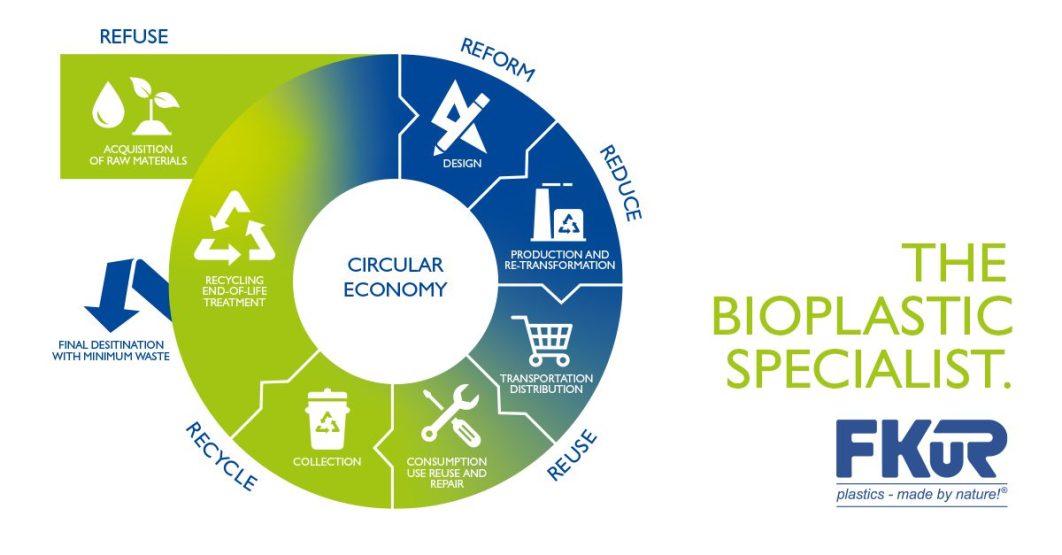
All products, parts and materials should be used for as long and as efficiently as possible. Repairing, refurbishing and reusing products can further extend their useful life and prevent waste. If reuse is no longer possible, the products are broken down into their original materials and recycled. The circular economy can therefore help conserve natural resources, minimise environmental impact and create a competitive, innovative economy.
Our conclusion: Consumption and production must move away from the idea of single use. The linear economy is proving to be a one-way street. The circular economy is therefore an important step towards tackling the global challenges of our time.
Reuse, recycle, close the loop!
For us, one thing has long been clear: nature should be a model for us all. Everything it produces is needed, used and utilised. There is no waste, only valuable resources. What if the life cycle of plastic products were modelled on nature’s closed loop? Waste could then be turned into valuable materials. If plastics were also produced from renewable resources, the loop could be extended even further.
After use, plastics must be disposed of correctly and returned to the raw material cycle through recycling. After all, plastics have become an indispensable part of our lives. Plastics are found in our clothing and cosmetics, everyday aids, consumer goods and vehicles. In medicine and packaging, they have become a standard material. And although they are used in many different ways and on a daily basis, plastic often has a poor reputation. The common prejudices are that it is made from finite fossil resources and, when used as packaging, is thrown away after a single use.
Considering material and product
For us, the circular economy begins with a clear question: What should happen to a product after it has been used? FKuR supports companies in selecting suitable plastics for defined applications. Depending on the product requirements, biobased plastics, recyclates or materials for a specified recovery route, such as organic recycling, may be considered.
Our bioplastics are already used by many customers in the packaging, household goods, writing instruments, furniture, toy and consumer goods industries, as well as in agricultural and horticultural applications. They are processed using methods such as injection moulding, extrusion, thermoforming and blow moulding. For us, even more exciting than looking back at successful products is looking ahead to ideas for new products and projects that have yet to be developed. Get in touch with us. Together, we will narrow down suitable material options and determine which possibilities are available for your product.
Learn more about the circular economy and the “8R” principles, “What are Bioplastics?” and “What are recyclates?” in our knowledge section.