
PPWR Explained: 9 Common Misconceptions and What the Regulation Really Requires
The new EU Packaging Regulation, the Packaging and Packaging Waste Regulation (PPWR), fundamentally changes the requirements for packaging. Regardless of the material used, it applies to all packaging and packaging waste and will generally become applicable from 12 August 2026. For converters and brand owners, it is therefore more important than ever to align packaging at an early stage with recyclability requirements, the use of recycled content, the potential use of bio-based or biodegradable plastics, and other regulatory obligations. Despite this, many misconceptions about the Packaging and Packaging Waste Regulation (PPWR) persist. These myths can become costly later on — leading to delays, material shortages, or unnecessary redesigns.
On-Demand Webinar: Understanding and Implementing the PPWR
The PPWR introduces new requirements for packaging, materials, and compliance documentation. In our webinar, we provide practical insights into what companies need to consider now and how to develop a future-proof materials strategy. Watch it for free on demand.
Knowledge that drives progress-
Access the webinar now for free!
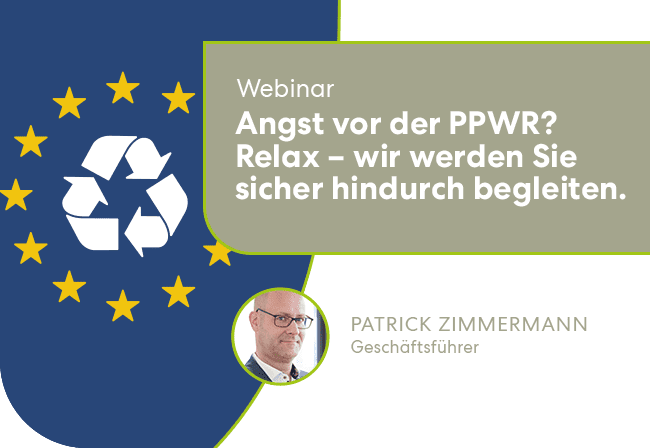
Watch the webinar recording for free and benefit today from our free know-how.
No time or missed the webinar?
Here’s how to access our free webinar recording:
- Fill out the form and click on "Get the recording now".
- Check your inbox and confirm your email address.
- You will receive the link to the recording by email from us.
PPWR Myth #1: Companies Still Have Plenty of Time to Prepare for the EU Packaging Regulation
Not quite. The Packaging and Packaging Waste Regulation (PPWR) entered into force on 11 February 2025 and will generally apply from 12 August 2026. Companies that delay preparation until shortly before the deadlines risk creating unnecessary pressure on packaging development, procurement, supplier qualification, and regulatory approval processes. The transition involves much more than redesigning packaging. Businesses must review and, where necessary, adapt material choices, supply chains, compliance documentation, certifications, and internal processes. Early planning is particularly important when incorporating recycled plastic content (recyclates), as testing, validation, and supplier alignment can take significant time.
For a complete overview of PPWR requirements, implementation timelines, and key compliance deadlines, read our guide: “EU Packaging Regulation (PPWR): Key Requirements, Deadlines, and What Businesses Need to Know.“
EU Packaging Regulation (PPWR): Myth #2 – Only Plastic Packaging Is Affected
The statement is incorrect. The Packaging and Packaging Waste Regulation (PPWR) applies across all packaging materials, including plastic, paper, cardboard, glass, and metal. It is therefore material-neutral and does not focus exclusively on plastics. Switching from plastic to paper or any other material does not automatically exempt packaging from regulatory requirements. Instead, compliance is increasingly determined by how circular and recyclable a packaging solution is in practice. This includes factors such as design for recycling, sorting compatibility, and real-world recyclability performance within waste management systems.
As a result, material choices are becoming more strategic. Solutions that combine functionality with circularity are gaining relevance, for example recycled content materials (recyclates) and, in suitable applications, bio-based plastic solutions that can support circular economy objectives under the PPWR framework.
PPWR Compliance Myth #3: Why Recyclable Packaging Is Not Automatically Sustainable
This assumption is also too simplistic. The Packaging and Packaging Waste Regulation (PPWR) does not focus solely on theoretical recyclability. Instead, it emphasizes actual recyclability within existing collection, sorting, and recycling systems. In other words, a packaging solution that is only theoretically recyclable is no longer sufficient. What matters is whether it can be effectively processed in real-world waste management infrastructure. Problematic design features include, for example, multi-layer composite structures, hard-to-detect materials, dark or carbon-black colors, and unsuitable labels or adhesives, all of which can significantly reduce recyclability in practice. As a result, many packaging formats that are still considered sustainable today may no longer meet future PPWR requirements. This makes Design for Recycling (DfR) a core development principle for companies. For practical approaches and inspiration, see our “8 Simple Ideas for Sustainable Product Packaging Design.”
PPWR Compliance Myth #4: Recycled Plastic Content (Recyclates) Will Be Easy to Source Later
Companies should not rely on this assumption. As the share of recycled materials (recyclates) increases, so does demand for suitable quality grades, especially for more demanding packaging applications. Even today, certain segments already face price increases and supply constraints. This trend is expected to intensify as regulatory requirements under the Packaging and Packaging Waste Regulation (PPWR) drive higher demand for recycled content across industries. It is therefore essential to evaluate early on:
- which types of recycled plastics and secondary raw materials are technically suitable for specific packaging applications,
- which alternative material options are available,
- and how packaging can be designed for long-term circularity, recyclability, and resource efficiency.
In particular, for packaging that incorporates recycled content (recyclates) and potentially bio-based plastic solutions, a robust and forward-looking material strategy becomes a clear competitive advantage under future PPWR requirements.
PPWR Compliance Myth #5: The EU Packaging Regulation Does Not Affect SMEs
This is not correct. Small and medium-sized enterprises (SMEs) are also affected by the EU Packaging and Packaging Waste Regulation (PPWR). The regulation applies to all companies placing packaging on the EU market, including manufacturers, converters, importers, distributors, and brand owners—regardless of company size. As a result, SMEs must also comply with requirements such as conformity assessments, technical documentation, labeling obligations, and evidence regarding recyclability and recycled content (recyclates). For many mid-sized companies, the key challenge is to implement these requirements in a practical and cost-efficient way. Integrating compliance considerations early in product and packaging development helps reduce redesign efforts, costs, and operational disruption later in the process.
PPWR Compliance Myth #6: Packaging Compliance Is a One-Time Approval
This is not how the Packaging and Packaging Waste Regulation (PPWR) works. Compliance is not a one-time status but an ongoing process. If there are changes to materials, suppliers, formulations, or packaging design, the compliance assessment under the EU Packaging and Packaging Waste Regulation (PPWR) must be reviewed and updated accordingly. In addition, further technical requirements and future implementing measures are expected to refine or expand obligations over time. This means companies need packaging solutions that are not only compliant today but remain robust and adaptable over the long term, capable of meeting evolving regulatory and technical requirements without requiring constant redesign.
PPWR Compliance Myth #7: PCR Recycled Plastics Alone Ensure Compliance with EU Packaging Rules
Post-consumer recycled (PCR) content plays an important role in the circular economy, but it is not sufficient on its own to meet the requirements of the EU Packaging and Packaging Waste Regulation (PPWR). The PPWR takes a holistic approach to packaging compliance. In addition to the use of recycled materials, it considers multiple criteria, including recyclability, design for recycling, material combinations, labeling, material reduction, and documentation requirements. Furthermore, not every type of recycled plastic (recyclate) is suitable for every application. In practice, factors such as availability, quality consistency, color, odor, and mechanical performance are critical for usability in real packaging systems. Companies should therefore evaluate early which material solutions are technically feasible, regulatorily compliant, and economically viable under real-world conditions.
PPWR Compliance Myth #8: Bio-Based Plastics Cannot Be Combined with Recycled Content
This is incorrect. Modern material technologies show that bio-based raw materials and recycled content (recyclates) can be technically combined in meaningful ways, depending on the application. Whether and to what extent such solutions will be recognized within the regulatory framework of the EU Packaging and Packaging Waste Regulation (PPWR) is currently still being clarified. However, the European Commission (EU) is expected to assess by 12 February 2028 whether bio-based plastics could be considered as an alternative to recycled plastics for meeting future quota requirements. In the meantime, companies should carefully evaluate hybrid material strategies that balance performance, circularity, and regulatory compliance, as both material streams are expected to play a role in future packaging systems.
PPWR Myth #9: The Packaging and Packaging Waste Regulation (PPWR) Only Applies to Food Packaging
This is incorrect. The Packaging and Packaging Waste Regulation (PPWR) applies across industries to nearly all packaging placed on the EU market. This means it does not only cover food and beverage packaging, but also packaging used in cosmetics, industrial goods, consumer products, and shipping and distribution systems. In particular, transport packaging and e-commerce packaging solutions are increasingly in focus under the regulation. As a result, many companies outside the food sector face a greater need for action than initially expected, especially when it comes to design, material selection, recyclability, and compliance documentation under the EU Packaging and Packaging Waste Regulation (PPWR).
What Companies Should Learn from the PPWR Myths
The EU Packaging and Packaging Waste Regulation (PPWR) is set to significantly and permanently transform the packaging market. For companies, the key focus areas will increasingly be recyclable packaging design, effective use of recycled content (recyclates), functioning material cycles, and economically viable solutions. This is precisely where the most important competitive advantages will emerge. Companies that act early will be better positioned to meet upcoming regulatory requirements and reduce future risks.
How well are your packaging solutions prepared for the PPWR?
Whether recyclates, bio-based plastics, or recyclable packaging concepts, requirements for materials and packaging design are increasing significantly. We support converters and brand owners in developing future-ready material strategies that combine regulatory compliance, technical performance, and sustainability in a practical and effective way. Talk to us about:
- the use of recycled content (recyclates)
- bio-based plastic solutions
- Design for Recycling (DfR)
- material concepts that meet PPWR requirements
- future-proof packaging strategies
Now is the right time to make packaging fit for the future.